No products added!


Written by
Μάνος Στειακάκης
Fluid – Crystallized Intelligence is a fundamental theory of cognitive psychology that decisively influenced the scientific approach to human intelligence. The theory of fluid and crystallized intelligence was developed by the British-American psychologist Raymond Cattell, in collaboration with his student John Horn. Cattell contributed significantly to the understanding and measurement of human intelligence, as well as to the investigation of the basic dimensions of personality. He was the one who initially proposed the distinction of intelligence into fluid and crystallized, while Horn continued and further developed these two concepts.
Fluid – Crystallized Intelligence constitutes an extremely important theory, as it offers a solid foundation for a deeper understanding of how our cognitive abilities develop and function.
But what are fluid and crystallized intelligence?
Fluid – Crystallized Intelligence
Fluid Intelligence
Fluid intelligence is the ability of an individual to think rationally and solve problems independently of the knowledge and experiences they possess.
Crystallized Intelligence
Crystallized intelligence is the ability of an individual to handle problems based on the knowledge they have acquired and their previous experiences.
Πηγή: https://www.structural-learning.com/post/fluid-intelligence
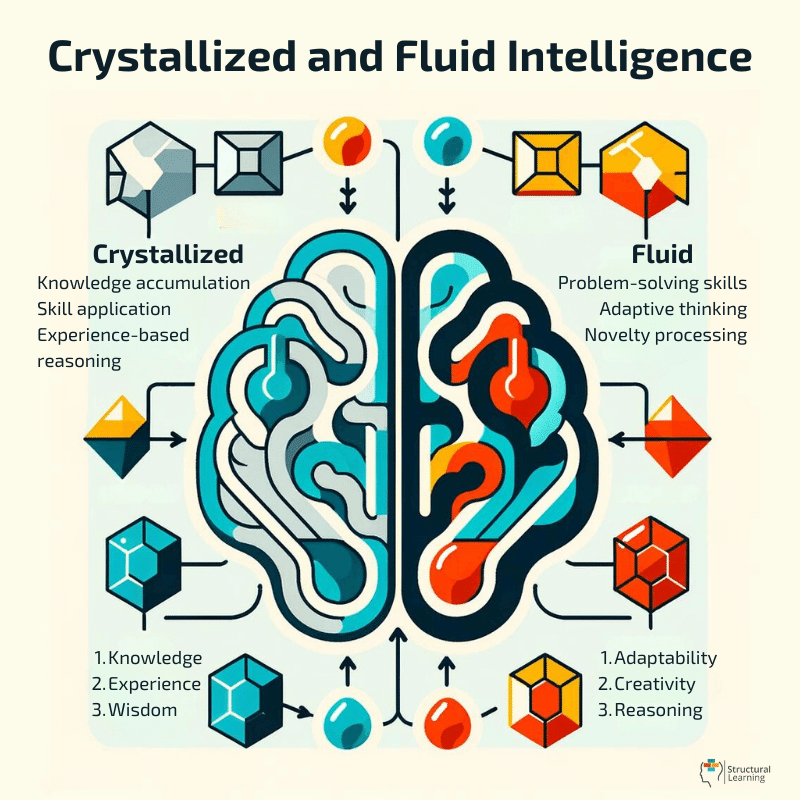
Fluid intelligence is essential when facing a new problem that cannot be solved either with our existing knowledge or our experiences. A simple example is when we try to find the differences between two otherwise identical pictures. The perceptual ability required for this concerns fluid intelligence. As shown in the figure, the structural components upon which fluid intelligence is based are adaptability to new situations, creativity, and logical thinking.
On the other hand, if we need to solve a mathematical problem based on the knowledge we have about this type of problem (mathematical formulas, relationships, etc.), then we are referring to crystallized intelligence.
Correspondingly, the structural components upon which crystallized intelligence is based are fully encompassed within the concept of Fluid – Crystallized Intelligence. These include existing knowledge, experiences, and wisdom in general that we possess, meaning a deep understanding of things.
The Fluid – Crystallized Intelligence is a dynamic combination of skills that evolves constantly throughout an individual's lifespan. It affects the way we approach problems and learn new skills.
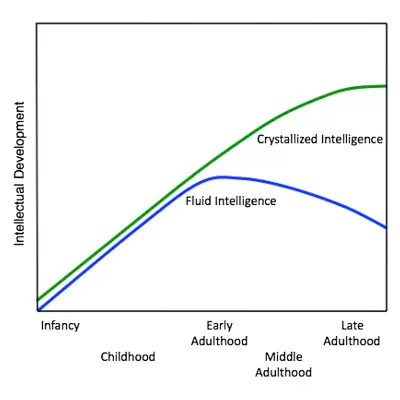
But how do these two forms of Fluid – Crystallized Intelligence evolve? Fluid intelligence develops mainly during childhood and peaks at the end of adolescence or in the early years of adult life.
It has been found that some characteristics of fluid intelligence may improve slightly even after the age of 30. Thereafter, a gradual decline is observed, although the rate of this decline depends on many factors such as health, mental exercise, and engagement in creative activities.
Crystallized intelligence, which is an equally important component of Fluid – Crystallized Intelligence, increases as the individual grows older, since more and more knowledge and experiences are accumulated. Its maximum value is observed around the age of 60 or 70 and depends, like fluid intelligence, on many external and internal factors.
A simple depiction of the chronological evolution of both fluid and crystallized intelligence is presented in the relevant figure.
Πηγή: https://www.sciencedirect.com/topics/computer-science/fluid-intelligence
What should be highlighted is that Fluid – Crystallized Intelligence does not consist of two entirely independent concepts. On the contrary, fluid intelligence plays a crucial role in transferring information into an individual's memory, information which subsequently serves as a basis for crystallized intelligence. In other words, the interaction between fluid intelligence and crystallized intelligence enhances the overall cognitive ability of the person.
The eSmartComp platform utilizes both of the above forms of Fluid – Crystallized Intelligence through the specialized tests it offers. However, particular emphasis is given to fluid intelligence, because in the age groups targeted by eSmartComp, fluid intelligence is developing and peaking. The questions evaluate the perceptual ability of the examinee, meaning their ability to think correctly and quickly for each of the seven categories of abilities examined in the test.
Which abilities does the eSmartComp platform assess?
-
Verbal (or Linguistic)
-
Logical-Mathematical
-
Spatial
-
Interpersonal
-
Intrapersonal
-
Digital
-
Innovative
The questions in a test that the examinee is asked to perform include, for example, **pattern recognition**, **creativity outside conventional frameworks**, **logical thinking** for finding relationships between numbers, etc. All of these are characteristics of **fluid intelligence** and develop, as previously mentioned, up to the first years of an individual's adult life. However, the eSmartComp platform does not ignore crystallized intelligence.
This is evident in the questions concerning decisions that the examinees must make or choices they must select. These are based on their previous experiences and/or elementary – basic knowledge that they must possess. When, for example, the examinee is asked to find the verbal analogies between words or phrases, crystallized intelligence is assessed, because what the examinee does to answer is to recall the meaning of known verbal formulations from memory.
However, in no case are there questions on the platform that concern specialized knowledge or advanced level knowledge. This is because their absence (at the time the test is conducted) is not connected to the lack or inadequacy of abilities needed for a young person's professional career. Simply put, at the given moment, the examinee does not possess that specific knowledge.
All that was mentioned previously constitutes the comparative advantage of the eSmartComp platform. Carefully selected questions that reliably and accurately assess the 28 most representative skills categories for the 7 abilities (4 skills per ability) that a person needs to pursue a career today in scientific professions. These skills are naturally not the same, nor are they needed to the same extent, for all professions. The eSmartComp platform, in addition to the selection of questions, utilizes the different weighting of each skill in each of the examined professions in its calculations.
Previous Story
The Value of Multiple Intelligences Theory in eSmartComp
Next Story
No story to show
751