No products added!
The Value of Multiple Intelligences Theory in eSmartComp
July 1, 2025

Written by
Μάνος Στειακάκης
Multiple intelligence is a term introduced by Howard Gardner in 1983, changing forever the understanding of human intelligence. According to the theory of multiple intelligences, every individual possesses different types of intelligence, which develop in different ways and influence both their education and their professional path.
In the present article, we will get to know the 7 basic forms that multiple intelligence includes and we will see how they are assessed through the eSmartComp platform.
The 7 Basic Forms of Multiple Intelligence
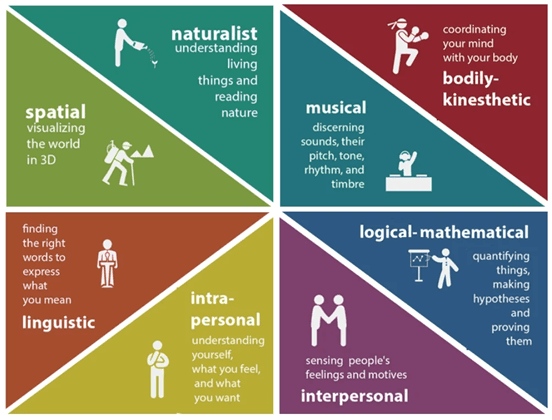
Linguistic
The ability to understand and express spoken and written language.
Logical-Mathematical
The ability to solve problems with logical reasoning and perform mathematical calculations.
Spatial
The ability to understand space and observe objects at a detailed level.
Musical
The ability to perceive rhythm and express emotions through the creation, performance, or interpretation of music.
Bodily-Kinesthetic
The ability to perform synchronized movements and manipulate objects with ease and harmony.
Interpersonal
The ability to communicate and perceive the emotions and motivations of other people.
Intrapersonal
The ability to perceive personal potential and achieve goals through individual work.
Several years later, in 1999, Gardner, in his book “Intelligence Reframed: Multiple Intelligences for the 21st Century”, proposed the 8th form of intelligence, the naturalist, meaning the ability to recognize, understand, and classify elements of nature, such as animals, plants, and natural phenomena.
Πηγή: https://www.simplypsychology.org/multiple-intelligences.html
In the same book, Gardner proposed yet another form related to multiple intelligence, the existential. This form concerns the ability to answer existential questions, such as the meaning of life or whether truth is absolute or relative.
Nevertheless, the existential form was not included in the initial framework of multiple intelligences, as further scientific investigation is required to determine if it meets the criteria for intelligence.
The theory of multiple intelligences essentially opposes the view that intelligence is a single, general ability that influences every area of our lives. It also rejects traditional IQ tests, which are limited to measuring linguistic, logical, and spatial ability.
According to the theory of multiple intelligences, every person has a unique combination of the eight basic forms of intelligence. This means that everyone can develop each of the eight forms of intelligence to a sufficient level, with the right guidance and effort.
The theory of multiple intelligences has also received criticism, mainly because it has not been empirically proven. Additionally, some argue that many abilities included in the theory of multiple intelligences could simply be characterized as talents.
Nevertheless, society tends to recognize as "intelligent" those individuals who excel in language or mathematics. However, according to multiple intelligence, other abilities – such as musical creation – are equally important.
Thus, a person with a particular talent for music, even if they aren't good at mathematics or language, may possess a high level in one of the forms of multiple intelligence. Creativity and the contribution of new cultural values constitute an undeniable element of intelligence, as defined by the theory of multiple intelligence.
A person who manages to survive in an isolated environment, utilizing nature and its elements, is a characteristic example of the naturalist form recognized by the theory of multiple intelligences. Adaptability to a new, unknown environment constitutes one of the most important criteria that describe intelligence according to the theory of multiple intelligences.
Intelligent, based on multiple intelligence, is also the individual who quickly perceives the intentions and motives of others, achieving effective cooperation. This describes interpersonal intelligence, yet another dimension that multiple intelligence takes into account.
It is clear that if we limited intelligence only to linguistic or mathematical ability, we would overlook a multitude of people with special skills and talents. Multiple intelligence rejects this limitation, as experience has shown that success does not depend exclusively on one or two skills.
Every person possesses a unique profile, a distinctive mixture of abilities. The eSmartComp platform utilizes the theory of multiple intelligences to identify and assess this mixture, enabling young people to further develop their own skills.
The eSmartComp platform, focusing on scientific professions, selects five basic forms from Gardner's theory of multiple intelligences: linguistic (verbal), logical-mathematical, spatial, interpersonal, and intrapersonal.
The eSmartComp platform, focusing on scientific professions, selects five basic forms from Gardner's theory of multiple intelligences: linguistic (verbal), logical-mathematical, spatial, interpersonal, and intrapersonal.
Today, the use of digital technologies and the development of innovations constitute two fundamental areas of evolution. Digital skills and the ability to innovate are now recognized as an integral part of multiple intelligences, especially in scientific professions.
For this reason, the eSmartComp platform has included two additional basic abilities, equally important as the traditional forms, thus reinforcing the holistic approach of multiple intelligences in the modern era.
Digital
The ability to adapt to the continually developing digital environment, not only regarding the use of digital devices but also regarding human behavior due to digital technology.
Innovative
The ability to create, implement, and apply new ideas, products, or processes that improve and/or add value to a specific field or problem.
In conclusion, the eSmartComp platform assesses a young person in 7 abilities:
-
Verbal (or Linguistic)
-
Logical-Mathematical
-
Spatial
-
Interpersonal
-
Intrapersonal
-
Digital
-
Innovative
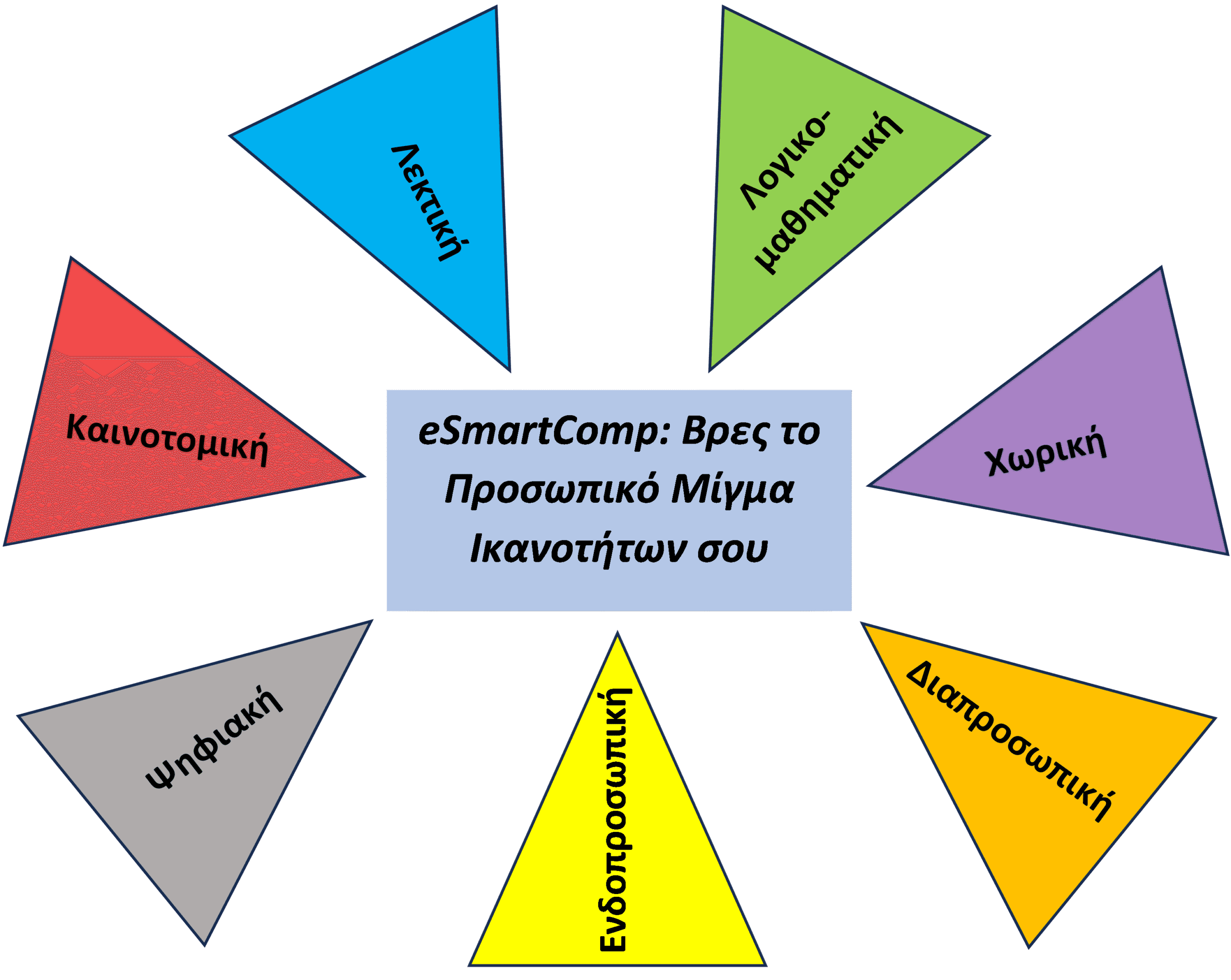
Thus, every young person has the ability to recognize their personal mixture of abilities through a systematic self-assessment process that is based on the theory of multiple intelligences and is offered by the eSmartComp platform.
The platform, through specialized tools and tests, helps the user realize which of the seven basic abilities of multiple intelligences dominate their own profile. Simultaneously, it offers detailed feedback and practical advice on how to improve and develop each of these abilities separately.
With the help of targeted activities and by setting personal goals, each user can focus on their specific needs and potential. Thus, they gradually build a more comprehensive skills profile, utilizing the advantages of multiple intelligences.
This process enhances self-awareness, self-confidence, and the ability for lifelong learning, preparing the young person for a future with more choices and opportunities both on a personal and professional level.
Previous Story
No story to show
636